
We Found the Perfect Job Posting for Everything Wrong with AI Marketing
Dec 10, 2025
Someone is hiring a human to be the wetware in their AI content factory. 108 pieces of content, generated entirely by prompts, with explicit instructions to NOT think, NOT improve, and NOT deviate. This is the logical endpoint of "AI-powered marketing" done badly
TL;DR: Someone is hiring a human to be the wetware in their AI content factory. 108 pieces of content, generated entirely by prompts, with explicit instructions to NOT think, NOT improve, and NOT deviate. This is the logical endpoint of "AI-powered marketing" done badly. And it's exactly why most AI-generated content will never appear in AI search recommendations. The companies treating content like a commodity are about to discover that LLMs don't cite slop. They cite substance.
You've heard the noise. AI is transforming content marketing. Everyone needs to "scale content production." Thought leadership at the push of a button. Blah blah blah.
But what nobody is telling you: the way most companies are using AI for content is creating a tsunami of undifferentiated garbage that's actively making them less visible, not more.
We're not talking about some theoretical future problem. I'm talking about a job posting I saw this week that made me want to put my head through my desk.
Let me show you what's actually happening out there.
The Job Posting That Says the Quiet Part Out Loud
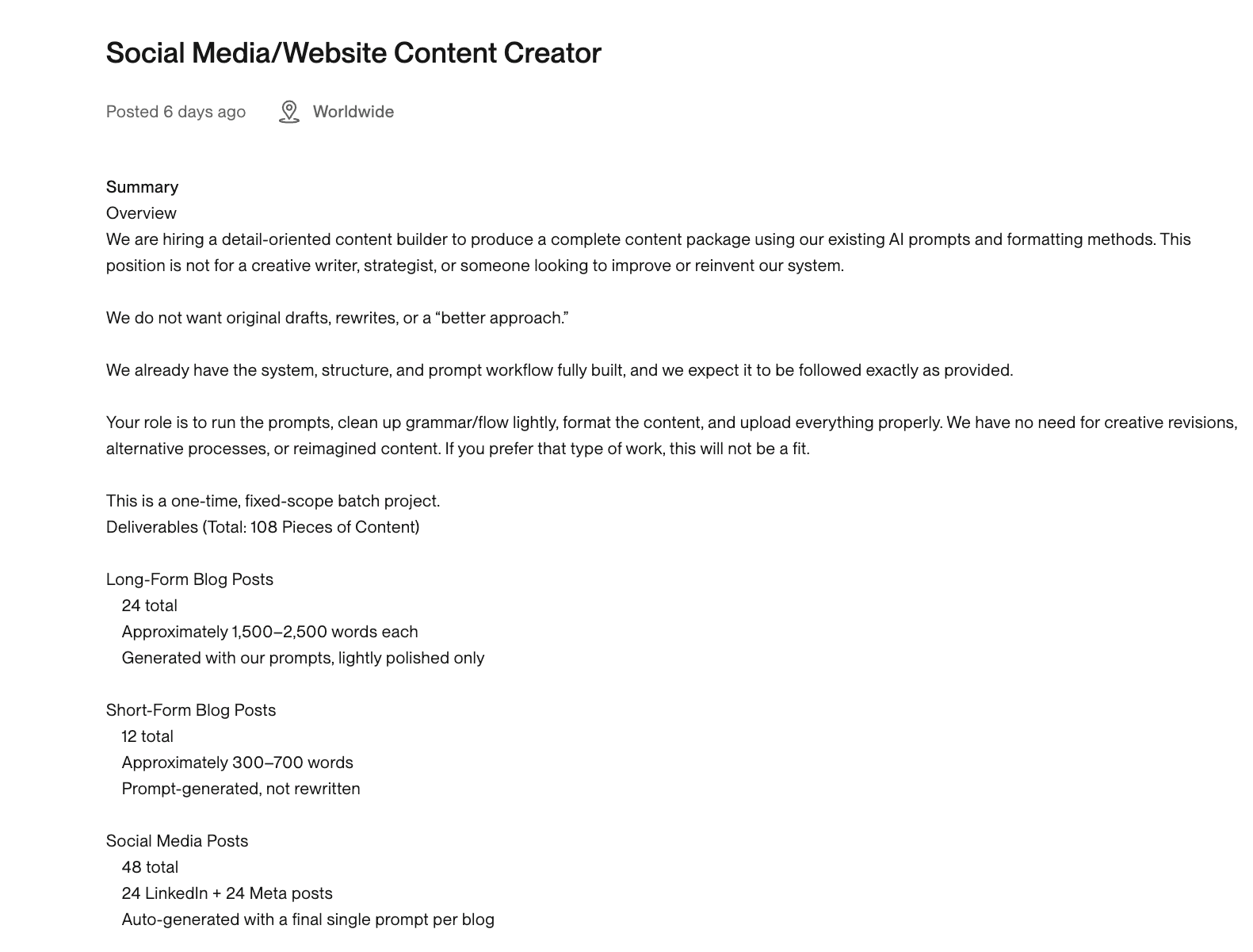
I stumbled across a freelance listing that's so perfectly illustrative of the problem, I almost thought it was satire. Here's what they're asking for:
The deliverables:
24 long-form blog posts (1,500–2,500 words each)
12 short-form blog posts (300–700 words)
48 social media posts
24 Google Business Profile posts
Canva images "as needed"
Total: 108 pieces of content.
Sounds like a decent content package? Here's where it gets interesting.
The posting explicitly states (and I'm not exaggerating here) that they do NOT want:
A creative writer
A strategist
Someone to improve the system
Original drafts
Rewrites
A "better approach"
Direct quote: "We do not want original drafts, rewrites, or a 'better approach.' We already have the system, structure, and prompt workflow fully built, and we expect it to be followed exactly as provided."
And: "Creativity is not required, and we do not want the content re-written, expanded, or re-concepted beyond basic human polish."
And my personal favourite: "We are looking for someone who executes efficiently, not someone looking to innovate."
They're hiring a human to copy-paste AI outputs and upload them to WordPress. That's the job. That's the entire job.
What They Think They're Building
I get it. I really do.
Content at scale sounds amazing. You build a system once, run it forever, watch the leads roll in. The economics are seductive. Why pay a writer £500 per article when you can pay someone £50 to run prompts and hit publish?
And look, there's nothing inherently wrong with using AI to accelerate content production. We use AI tools constantly. The difference is in what you're accelerating towards.
This company has built a system optimised for one thing: output volume. 108 pieces of content, generated as fast as possible, with minimal human involvement.
What they haven't considered is whether any of that content will actually do anything.
Why This Approach Is Already Obsolete
Here's what nobody's talking about: the same AI tools being used to create content are also being used by your buyers to evaluate it.
When someone asks ChatGPT "what's the best [solution] for [problem]," the LLM doesn't just search for keywords. It synthesises information, evaluates credibility, and makes recommendations based on the quality and distinctiveness of the content it finds.
And here's what LLMs don't recommend: generic, templated, obviously-AI-generated content that sounds exactly like everything else.
Think about it from the AI's perspective. If you've trained on billions of pages of content, you can recognise when something is just... more of the same. There's nothing to cite. Nothing distinctive to reference. No reason to recommend it over the thousand other pieces saying identical things.
The content factory model worked when the audience was humans scanning Google results. It's catastrophically wrong for an era when AI tools are curating what humans see in the first place.
The Citability Problem
Let me translate this into something concrete.
For your content to appear in AI search recommendations (ChatGPT, Perplexity, Claude, whatever), it needs to be citable. The LLM needs a reason to reference you specifically, rather than synthesising generic information from multiple sources.
What makes content citable?
Original data. Did you actually research something? Run a survey? Analyse your own client results? That's citable.
Specific insights. Not "content marketing is important" but "we tested 47 headlines and found that questions outperformed statements by 34% in B2B fintech." That's citable.
Genuine expertise. Perspectives that could only come from someone who's actually done the thing, not someone who's summarised what other people wrote about doing the thing.
A distinctive point of view. An opinion. A framework. Something that makes you sound like you, not like every other ChatGPT output.
Now look at that job posting again. They're explicitly forbidding all of this. No original thinking. No improvement. No deviation from the prompts. Just volume.
The content they produce will be technically correct, grammatically fine, and completely invisible to the AI tools their buyers are increasingly using to find solutions.
The Real Cost of Cheap Content
I can hear the objection: "But it's so much cheaper! 108 pieces of content for probably £1,000-2,000!"
Let's do the maths.
Scenario A: The Content Factory
108 pieces of AI-generated content
Cost: Let's say £2,000
AI search visibility: Near zero (nothing distinctive to cite)
Buyer engagement: Low (sounds like everyone else)
Pipeline generated: Minimal
Scenario B: Fewer, Better Pieces
12 pieces of genuinely differentiated content
Cost: Let's say £6,000
AI search visibility: High (original insights, citable data)
Buyer engagement: Strong (sounds like experts)
Pipeline generated: Meaningful
The factory approach costs less per piece but delivers approximately nothing. The quality approach costs more but actually appears where buyers are looking.
This isn't about being precious or anti-AI. It's about understanding that the game has changed. Volume without distinctiveness is just noise.
What Good AI-Enhanced Content Actually Looks Like
I want to be clear: we use AI tools constantly. They're brilliant for:
First drafts that capture the structure and key points
Research synthesis and identifying patterns
Editing and tightening prose
Generating variations for testing
Repurposing content across formats
What AI tools can't do (at least not without heavy human direction) is provide the things that make content citable:
Your actual experience and what you learned from it
Data from your specific work with clients
Opinions that come from having a genuine point of view
The ability to say "here's what everyone gets wrong" and back it up
The model isn't "AI does everything" or "humans do everything." It's "humans provide the substance, AI provides the speed." That's where the leverage actually is.
The Bit Nobody Wants to Hear About Your Content Strategy
I'm going to be blunt: if you're currently treating content as a volume game, you're building on a foundation that's already crumbling.
The companies that will win in AI search aren't the ones publishing the most. They're the ones publishing things worth citing. Things with original data. Things with genuine expertise. Things that AI tools can point to and say "this company actually knows what they're talking about."
And here's the really uncomfortable bit: most of your competitors haven't figured this out yet. They're still optimising for Google rankings and publishing schedules. The window to own your category in AI search recommendations is open right now.
But not if you're hiring humans to upload AI slop.
What You Should Actually Do This Month
Forget the 108-piece content factory. Here's what actually moves the needle:
Week one: Ask ChatGPT, Perplexity, and Claude who the best [your category] companies are. Are you being mentioned? Screenshot everything. This is your baseline.
Week two: Audit your existing content. How much of it contains original data, specific client results, or genuine insights? How much of it could have been written by anyone? Be honest. If it sounds generic, it probably is.
Week three: Identify 3-5 topics where you have genuine expertise and actual data. Not opinions about industry trends. Real insights from real work you've done. That's your content foundation.
Week four: Create one piece of content that includes something citable. Original research. Client results (anonymised if needed). A framework you actually use. Something an LLM would have a reason to reference.
That's it. Four weeks, and you've started building content that matters instead of content that exists.
Why This Might Actually Be Good News
Here's what I find genuinely exciting about this shift: it rewards substance over volume.
For years, content marketing has been a game of "who can publish the most optimised posts fastest." The winners were often the companies with the biggest budgets for content mills, not the companies with the best expertise.
That's changing. AI search tools are acting as a quality filter that Google never was. They're recommending the companies that actually know things, not the companies that published the most "Ultimate Guides."
If you're a company that's genuinely good at what you do, if you have real expertise, real results, real insights, this is your moment. The playing field is tilting toward the companies that deserve to win.
But only if you stop treating content as a commodity. Only if you recognise that one piece of citable content is worth more than a hundred pieces of AI-generated filler.
The company that posted that job listing is about to produce 108 pieces of content that will do absolutely nothing for their AI visibility. By the time they figure out why, you could already own the AI search recommendations in your category.
The question isn't whether content factories will become obsolete. They already are. The question is whether you'll adapt before your competitors do.
People Also Ask
Is AI-generated content automatically bad for AI search visibility?
No. It's about how you use it. AI-assisted content that includes original insights, data, and genuine expertise can perform extremely well. The problem is AI-only content with no human substance. LLMs can tell the difference, and they cite the former while ignoring the latter.
How much content do I actually need to publish?
Less than you think. One genuinely distinctive piece per month will outperform twelve generic ones. Focus on making everything you publish citable. That means containing something that gives AI tools a reason to recommend you specifically.
What if my competitors are already doing this better?
Then you're behind, but not dead. Most companies are still optimising for old-school SEO, not AI search visibility. Start building citable content now, and you can catch up faster than you'd expect. The game is still early.
Should I fire my content agency if they're doing this?
Have the conversation first. Ask them: "How are you optimising our content for AI search recommendations?" If they look confused or start talking about keywords, that's a red flag. A good agency should already be thinking about citability, original insights, and GEO. If they're not, find one that is.
Want to know if your content is actually visible to AI search tools? We run free visibility audits that show you exactly where you're appearing, and where you're invisible. [Book a 15-minute call] and we'll show you the data.
Stop blending in.
Start breaking through.
Book a free 30-minute call and let's figure out how to make your marketing actually differentiate you.